
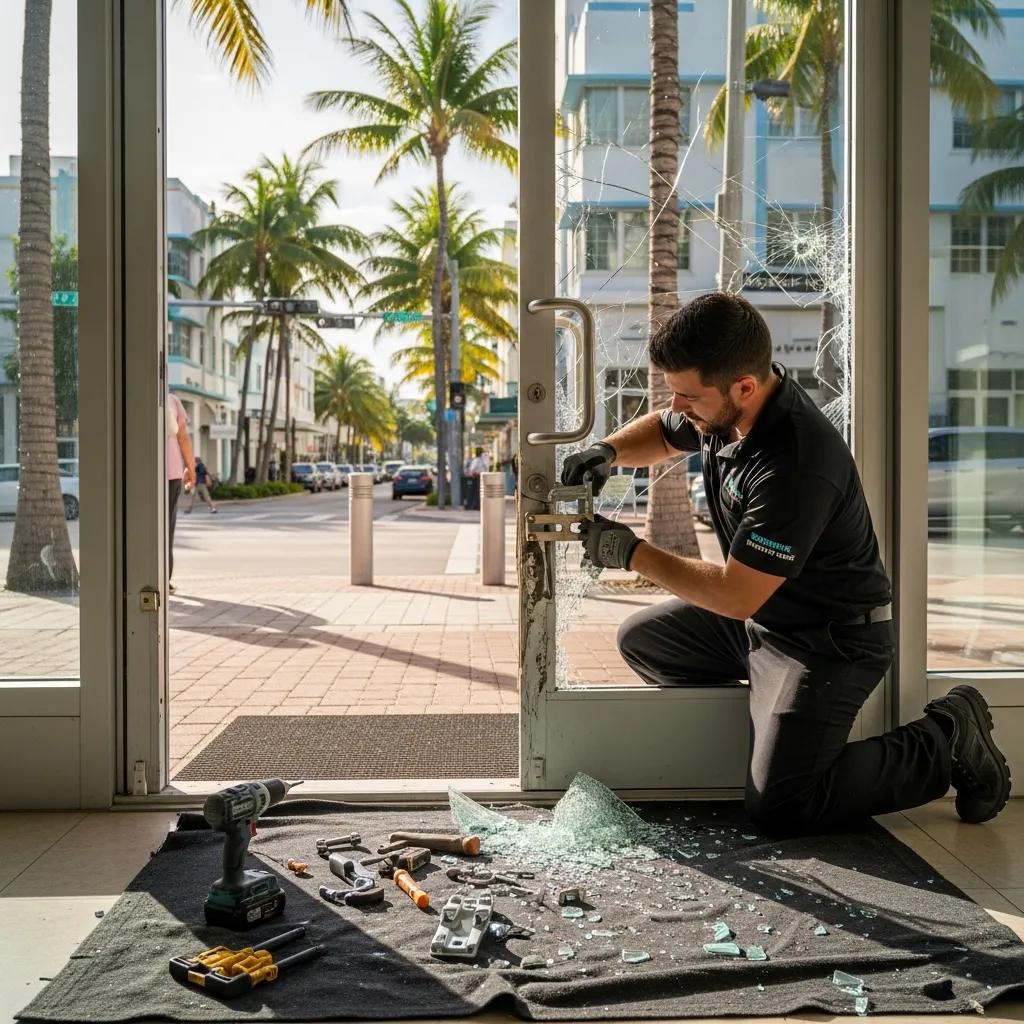
Emergency Door Repair Miami – 24/7 Commercial Door Repair Services
24/7 Commercial Door Repair: Safeguarding Miami Businesses
Miami businesses that rely on secure, operational entry points need fast, effective emergency door repair to maintain safety, protect assets, and keep operations running. This article explains why 24/7 emergency commercial door repair matters in Miami’s unique climate and regulatory environment, how rapid interventions limit downtime and liability, and what business owners should expect from a professional emergency response. Readers will learn the common commercial door failures in storefronts, automatic systems, fire-rated and impact doors, and access control systems, and they will get practical mitigation steps for immediate safety. The guide also outlines the types of doors routinely serviced, the on-site triage and repair actions used by technicians, and the logistical considerations for responding across South Florida and nearby Caribbean locations. Finally, the article describes how a licensed, insured 24/7 provider organizes dispatch, parts sourcing, and compliance testing so you can choose a provider who minimizes interruption and restores code-compliant security quickly.
Immediate problems such as broken storefront glass, failed closers on fire doors, or access control outages present distinct risks; this piece breaks each emergency into symptoms, interim containment measures, and permanent repairs so facility managers can triage incidents and communicate clearly with responders. Practical checklists and comparison tables help decision-makers prioritize safety, insurance reporting, and recovery steps after an incident. Throughout, the focus remains on real-world actions that reduce revenue loss, preserve life-safety systems, and protect property from weather and intrusion in Miami’s hurricane-exposed environment.
Why Is 24/7 Emergency Commercial Door Repair Essential for Miami Businesses?
24/7 emergency commercial door repair is essential because doors are primary security and life-safety interfaces for commercial buildings; when a door fails after hours, the risk to people, inventory, and revenue rises immediately. Rapid repair restores security to prevent theft and vandalism, maintains egress and fire-door integrity for occupant safety, and reduces the period a business is non-operational—directly limiting revenue loss. In Miami, climate factors such as high humidity and hurricane exposure increase the likelihood of sudden impact- or water-related failures, so access to round-the-clock services lowers both immediate and downstream risks associated with delayed fixes.
After describing these risks and the mitigation priorities, a practical provider connection point helps businesses move from problem awareness to action. Oratso Corporation offers licensed, insured 24/7 services across South Florida and the Caribbean, providing emergency dispatch, free estimates, and hurricane-rated solutions to quickly secure commercial properties. Contact details for Oratso Corporation are available to initiate an urgent response or request a no-obligation estimate by phone or email.
How Does Rapid Door Repair Minimize Business Disruption?
Rapid door repair minimizes disruption by implementing immediate triage, temporary containment, and expedited permanent repairs that restore safe operations as quickly as possible. Technicians begin with a safety assessment to prioritize life-safety systems (fire doors, panic hardware), then apply temporary measures such as boarding, boarding alternatives, or mechanical overrides to secure the premise while parts are sourced.
Quick parts sourcing, prioritized dispatch, and on-site diagnostics typically allow same-day or next-business-day resolutions for common failures, which keeps storefronts open and critical access points functioning. This sequence—assess, secure, repair—reduces lost sales and customer-facing downtime, enabling businesses to resume normal operations with documented repair actions for insurance and compliance follow-up.
An elementary EAV-style snapshot below clarifies typical triage actions and the resulting business outcomes:
This table shows how immediate containment bridges to permanent repair, reducing both safety exposure and revenue impact while providing documentation for insurance claims.
What Are the Security Risks of Delayed Commercial Door Repairs?
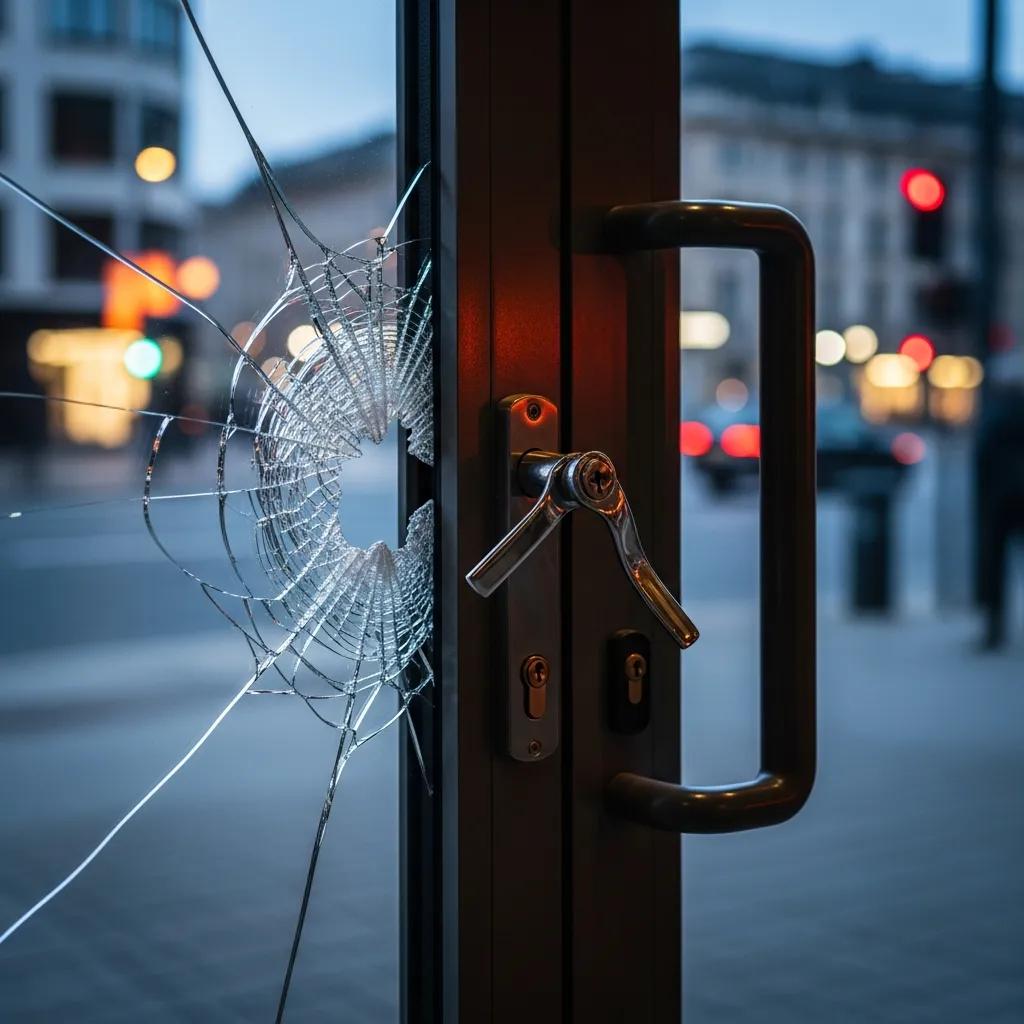
Delaying commercial door repairs increases security exposure for theft, vandalism, and unauthorized entry, and it can compromise life-safety functions required by code. A non-closing fire door or malfunctioning panic bar creates liability for property owners, elevates insurance complications, and may result in non-compliance with local safety standards. Prolonged access control outages can also expose sensitive systems and records, while broken storefront doors invite opportunistic crime and harm customer confidence. Short-term mitigations—such as mechanical overrides, temporary boarding, re-routing customer entry, and increased temporary staffing—reduce immediate risk while awaiting full repairs.
This highlights the crucial role of systems like access control and emergency exits, which are inherently safety- and security-critical components of any building.
Building Access Control & Emergency Exit Systems
fire alarm and access control as s&s service since they are safety- and security-critical. An office building equipped with a BACS allows occupants to exit the building via the emergency exits.
Safety-and security-critical services in building automation and control systems, 2009
Addressing these risks quickly also simplifies insurance documentation and claim support because repair records, incident photos, and professional interim measures demonstrate proactive care. The next section outlines the kinds of doors that commonly fail and the targeted emergency repairs technicians use to restore both security and regulatory compliance.
What Types of Commercial Doors Does Oratso Corporation Repair in Miami?
Commercial door repair specialists handle a broad set of door systems that each have unique emergency modes of failure and prescribed repair actions. Typical commercial door categories include automatic sliding and swinging doors, fire-rated doors, hurricane/impact-rated doors, storefront glass systems, and access control-integrated entrances, and each requires trained diagnostics and specific components to restore safe, code-compliant function. Understanding these categories helps building managers communicate the problem and expect the right parts and procedures during an emergency response. The list below summarizes common door types with one-line clarifications to aid quick identification.
Indeed, the scope of emergency repair services often encompasses a wide array of door and window systems, from standard to automatic.
Commercial Door & Window Emergency Repair Services
perform maintenance and repair of standard doors and windows, and provide emergency repair services for automatic doors and overhead bay doors as identified herein.
Installation, Inspection, Maintenance, and Repair of Doors and Windows on an Annual Contract with four, 2016
- Automatic doors: Sensor, operator, and safety edge failures require electrical and mechanical diagnostics.
- Fire-rated doors: Integrity depends on closers, seals, and tested hardware to maintain the rating.
- Impact/hurricane-rated doors: Structural framing and glazing systems must meet impact standards and be repaired to code.
- Storefront and glass doors: Broken glazing, misaligned frames, and panic hardware are prioritized for safety and appearance.
- Access control doors: Reader failures, wiring faults, and power issues often need coordinated electronic and mechanical fixes.
Before the repair table, note that rapid identification of the door type reduces wasted dispatch time and ensures technicians arrive with the most likely parts. The table below maps door categories to typical emergency issues and the repair actions or components commonly needed.
This table helps property managers anticipate parts, time-to-repair, and the technician skills likely required for each door category.
How Are Automatic Doors Repaired During Emergencies?
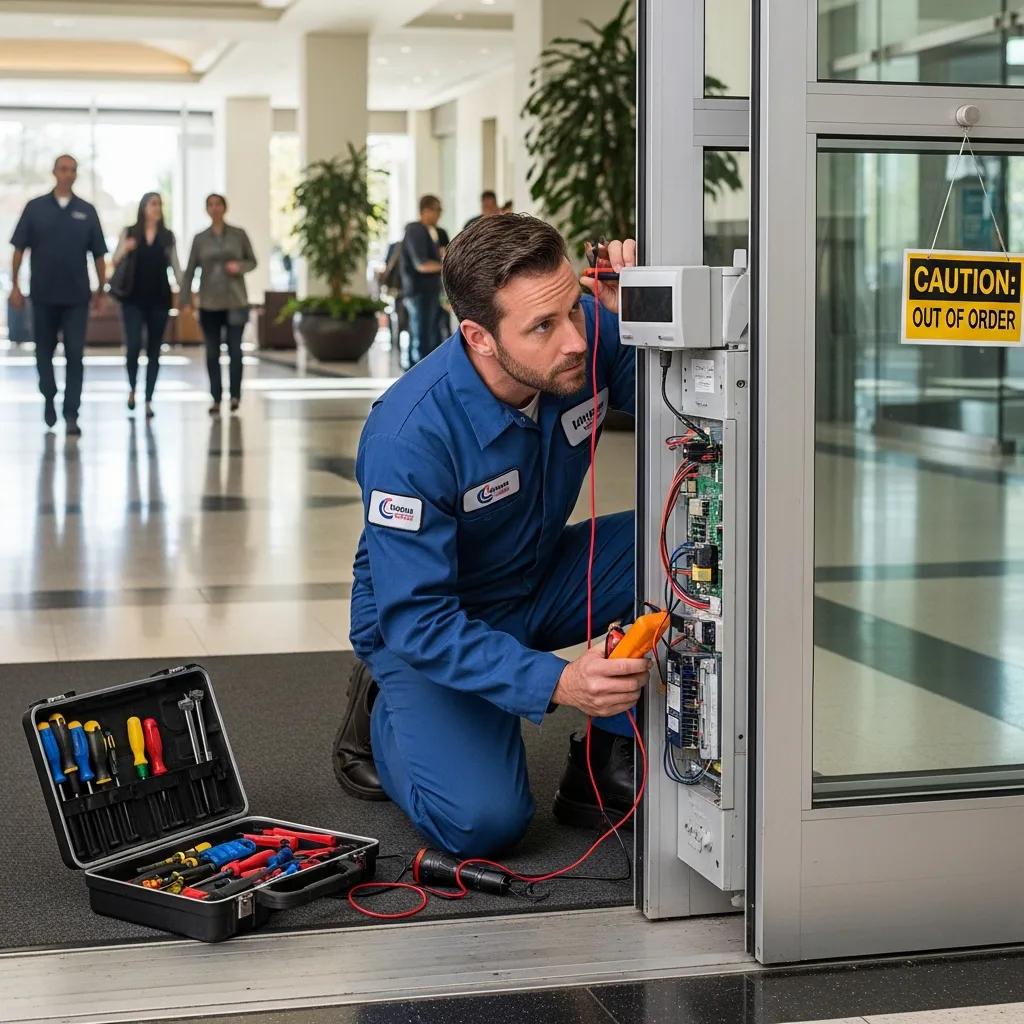
Emergency repairs to automatic doors focus first on safety: stopping unintended movement, securing the opening, and preventing entrapment, then diagnosing sensor, operator, and control faults. Technicians follow a rapid-diagnosis checklist—verify power, test safety edges, inspect operator drive assemblies, and run control board diagnostics—so they can determine whether a temporary manual mode or immediate part replacement is required. Common parts carried on emergency trucks include control modules, sensors, drive belts, and operator motors to enable same-day fixes where possible.
After the immediate repair, safety checks and sensor calibration ensure the door meets operational safety standards before the technician departs. Emergency measures prioritize occupant safety and access continuity, and they transition into permanent fixes that restore manufacturer tolerances and sensor reliability. The next subsection explains how fire-rated and impact doors are handled during urgent repairs, where compliance considerations play a larger role.
What Are the Key Features of Fire Rated and Impact Door Repairs?
Fire-rated and impact door repairs are governed by integrity and certification: the goal is to restore fire-resistance ratings and impact performance while using compliant hardware and documented testing where required. Emergency interventions often include replacing or adjusting closers to ensure positive latching, resealing door edges and thresholds to restore smoke and fire containment, and replacing glazing in impact-rated assemblies with approved materials. Technicians check relevant standards—such as fire door operation and labeling—and provide the necessary documentation post-repair to support compliance and insurance. Timelines vary depending on component availability, but interim measures secure the opening until certified parts are installed.
Maintaining the rating during and after repair requires careful selection of components and post-installation testing; this ensures both life-safety systems and hurricane resilience are not compromised by hasty repairs. The next major section describes how a reliable emergency provider structures response, credentials, and guarantees to deliver these outcomes consistently.
How Does Oratso Corporation Provide Reliable 24/7 Emergency Door Repair Services?
A reliable 24/7 emergency door repair service combines disciplined dispatch protocols, stocked parts inventory, licensed technicians, and clear client communications to deliver predictable outcomes for businesses in urgent situations. Oratso Corporation organizes emergency response through a centralized dispatch that triages requests, prioritizes life-safety incidents, and routes technicians with the appropriate skill set and stocked truck to the site. The company operates licensed and insured teams and emphasizes transparent estimates and documentation for every emergency job so clients can make informed decisions quickly. These operational elements—dispatch, inventory, and credentials—work together to reduce on-site time, expedite repairs, and provide the clarity facility managers need during incidents.
This table demonstrates how operational attributes map to measurable client outcomes such as minimized revenue loss and preserved code compliance.
Oratso’s operational model emphasizes documentation and client communication during emergency repairs, which helps businesses coordinate with insurance and internal stakeholders. The next two subsections cover the credentials that support reliable service and the client benefits of free estimates and rapid response.
What Experience and Certifications Support Oratso’s Expertise?
Technicians who respond to emergency commercial door incidents must combine mechanical, electrical, and code knowledge to return systems to safe, compliant operation; the provider’s support structure should reflect that need. Oratso Corporation staffs licensed and insured technicians who are trained in repairing automatic operators, fire-door hardware, impact-rated systems, storefront glazing, and access control interfaces. Licensing and insurance provide clients with a risk-managed repair process, while ongoing technician training maintains skills for up-to-date code compliance and manufacturer-recommended procedures. These trust signals reduce the administrative burden on clients and ensure that repair actions can be documented for regulatory and insurance purposes.
Experience in the field also means technicians can prioritize temporary containment measures correctly and recommend cost-effective permanent repairs. The next subsection explains how free estimates and rapid responses translate into tangible client benefits during emergencies.
How Do Free Estimates and Rapid Response Benefit Miami Clients?
Free estimates and rapid response reduce decision friction at critical moments by providing a clear scope, cost estimate, and timeline before work begins, enabling businesses to approve necessary repairs quickly and restore operations. Rapid dispatch shortens the exposure window for security and life-safety risks, while a no-obligation estimate helps facility managers compare repair options and budget implications immediately. A typical emergency timeline begins with a one-hour triage call, same-day interim measures, and prioritized parts ordering for permanent repairs, which often results in same-day or next-day resolution for common issues. This approach lowers total downtime costs and simplifies insurance claims by supplying prompt documentation of the incident and repair actions.
Requesting an emergency estimate or immediate dispatch can be the fastest way to stabilize an incident. Oratso Corporation provides 24/7 emergency dispatch, free estimates, licensed and insured technicians, and hurricane-rated solutions—contact information for initiating service is available to businesses needing immediate assistance.
What Common Commercial Door Emergencies Are Handled by Oratso Corporation?
Commercial door emergencies fall into recurring patterns that allow technicians to respond with prescribed triage and repair workflows; cataloging these incidents improves response speed and parts readiness. Typical emergencies include storefront glass breakage, panic-bar failures, automatic door malfunctions, access control outages, and compromised fire doors. Identifying the issue by symptom—such as jammed operators, visible glass fracture, or non-responsive card readers—enables a faster route to containment and permanent repair. The table below lays out common issues, observable symptoms, and the typical rapid-solutions with estimated response or repair actions to help facility teams prepare for conversations with responders.
This EAV-style comparison clarifies symptom → interim action → repair path for the most frequent emergencies.
Which Urgent Repairs Are Most Frequent for Storefront and Glass Doors?
Storefront and commercial glass doors commonly experience urgent issues such as shattered glazing, latch or lock failures, and frame misalignment, each of which affects safety, security, and customer access. Immediate priorities are to secure the opening to prevent unauthorized entry, protect pedestrians from glass hazards, and maintain a visible storefront presence where possible. Temporary glazing, protective film, or boarding may be used as an interim fix while the team sources matching glass and hardware for a full restoration. Typical repair timelines depend on glass fabrication and hardware availability, but many storefront emergencies can be stabilized within hours and fully restored within one to three business days when parts are available.
Properly documenting interim actions and the final repair plan also streamlines insurance claims and reduces operational uncertainty for business owners. The next subsection examines how access control outages are handled during emergencies, where electronics and wiring require coordinated responses.
How Are Access Control System Failures Addressed in Emergencies?
Access control emergencies combine electrical, network, and mechanical challenges, so responses prioritize both safe access and data/security integrity. Emergency technicians implement mechanical overrides or temporary power/failover solutions to restore entry while diagnosing the root cause—whether a failed reader, damaged wiring, or power supply issue. Coordinated troubleshooting between door hardware technicians and electronic access control specialists ensures that electronic fixes do not compromise mechanical security or life-safety functions. Temporary access protocols (e.g., secured manual entry, temporary cards) paired with logs of all interim measures help preserve security and provide a clear audit trail for post-incident analysis.
Restoring full access control function typically involves replacing failed components, correcting wiring faults, and validating failover behavior to prevent reoccurrence during power events or network interruptions.
Which Areas in South Florida and the Caribbean Does Oratso Serve for Emergency Door Repairs?
Emergency repair capability is shaped by regional coverage and logistical planning; effective providers list counties and cities served and explain expected response characteristics for each area. Oratso Corporation provides emergency door repair services across Miami-Dade, Broward, Palm Beach, Monroe, and Collier counties, and extends services to select Caribbean islands with cross-border logistics planning. Regional coverage includes commercial corridors, port-adjacent areas, and hurricane-exposed zones that require surge capacity and pre-positioned inventory. This distributed approach reduces travel time for emergency calls and helps prioritize critical infrastructure after severe weather or other regional events.
- Miami-Dade County: dense commercial corridors and port-adjacent sites with rapid urban dispatch.
- Broward County: major retail and office clusters with predictable response windows.
- Palm Beach County: larger site coverage areas requiring staged routing and parts logistics.
- Monroe & Collier Counties: island and coastal considerations with cross-water planning for Caribbean response.
What Counties and Cities Are Covered by Oratso’s 24/7 Services?
Oratso’s 24/7 coverage spans Miami-Dade, Broward, Palm Beach, Monroe, and Collier counties, ensuring emergency dispatch to major commercial centers in Miami, Fort Lauderdale, West Palm Beach, Key West, and Naples. Local dispatch hubs and technician routing balance proximity with specialized skills needed for certain door systems, while cross-jurisdiction permits and logistics are coordinated as required for larger jobs. Typical response expectations vary by distance and traffic patterns, with urban areas receiving the fastest arrival times and outlying coastal or island sites scheduled with prioritized routing.
Clear communication at the time of the emergency sets realistic expectations for arrival and interim security measures. These geographic capabilities support clients who need a single trusted provider for multi-site portfolios across South Florida and nearby islands.
How Does Oratso Handle Emergency Repairs in Hurricane-Prone Regions?
Handling emergencies in hurricane-prone regions requires surge staffing, pre-season inspections, and hurricane-rated inventory to prioritize repairs that restore structural integrity and protective glazing quickly after storms. Providers prepare by pre-positioning impact-rated materials, scheduling pre-season assessments, and maintaining protocols for rapid deployment following severe weather events. After a storm, teams triage commercial properties by safety-critical systems—fire doors, emergency exits, and impact-rated openings—then sequence repairs to prevent further water intrusion and structural compromise. Coordination with insurers and documentation of emergency measures and permanent repairs expedite claims and reduce recovery timelines for affected businesses.
The critical need for such preparedness is underscored by the significant structural vulnerabilities and economic losses that natural disasters like hurricanes can inflict on Florida.
Florida Hurricane Damage & Structural Vulnerability
Hazards such as tornadoes and hurricanes are natural disasters which causes human and economic losses. Next, the second project consist on a forensic analysis made to Florida Keys after Hurricane Irma. Irma landed at Florida Keys as a category 4 storm.
Tornado and Hurricane Hazards: Reconnaissance, Structural Analysis and Vulnerability Modeling, 2013
- Secure hardware: Tighten and inspect closers, hinges, and anchors.
- Document systems: Record door types, labels, and photos for insurance.
- Pre-arrange response: Establish emergency contact and priorities with your repair provider.
Oratso Corporation — Contact and Service Note
Oratso Corporation provides licensed, insured 24/7 emergency door repair services, free estimates, and hurricane-rated solutions across South Florida and selected Caribbean islands. For immediate emergency assistance or to request a no-obligation estimate, businesses can contact Oratso Corporation by phone at +1 305-888-2211 or by email at info@oratsocorp.com. The company’s local presence and emergency protocols are designed to reduce downtime, restore security, and document repairs for compliance and insurance purposes.